Repository navigation
Named state sets: optional name on @StateSet - #498
Merged
Merged
Conversation


Collaborator
Author
|
Codex review, round 1 (run locally before the first push)
|
Collaborator
Author
|
Codex review, round 2
|
Collaborator
Author
|
Codex review, round 3
|
Collaborator
Author
|
Codex review, round 4: no actionable findings (the full Maven suite passes). Review loop done. |
Collaborator
Author
Clean-code review (clean-code-principles)Reviewed the diff only, weighed against the standing rules (smallest PR that tests well, match surrounding style, no tidy-only refactors, lean tests).
Full suite locally after the fix: 714 tests, 0 failures. |


A named state set's ghost function takes that name instead of the generated
stateN, so messages, hints and the equalities that keep unmentioned sets
print e.g. redo(um), and specs can use it like any ghost (redo(old(this))).
Unnamed sets keep stateN. A name must be a lowercase identifier that is not
already a state, ghost or other state set of the class.

Co-Authored-By: Claude Opus 5.5 <noreply@anthropic.com>
Co-Authored-By: Claude Opus 5.5 <noreply@anthropic.com>
Co-Authored-By: Claude Opus 5.5 <noreply@anthropic.com>
Co-Authored-By: Claude Opus 5.5 <noreply@anthropic.com>
Co-Authored-By: Claude Opus 5.5 <noreply@anthropic.com>
Co-Authored-By: Claude Opus 5.5 <noreply@anthropic.com>
…lock set

Co-Authored-By: Claude Opus 5.5 <noreply@anthropic.com>

CatarinaGamboa
force-pushed
the
feat/435-named-state-sets
branch
from
November 9, 2026 17:12
c9a5ba1 to
1d67db4
Compare
This was referenced Nov 9, 2026
CatarinaGamboa
added a commit
that referenced
this pull request
Nov 9, 2026

Fixes #452

**Cause.** `MethodsFirstChecker` and `ExternalRefinementTypeChecker`
registered a type's `@StateSet`s and `@Ghost`s while visiting that type.
A spec read before the declaring type was visited could not see them.
For external specs that is #452: an interface in a spec file cannot use
states declared by an interface later in the same file.

**Fix.** A new first pass, `GhostsFirstChecker`, registers the ghosts
and state sets of every type, in the package and all its sub-packages,
before any spec is read. It runs after `FieldGhostsGeneration`, which
turns fields into ghosts, and before the existing passes. It also
registers `@RefinementPredicate` ghosts, which are only allowed on
types, so the name checks for state sets from #498 still see them.

External specs keep their naming under the refined class through a new
`ExternalRefinementTypeChecker.registerGhosts`. The "could not find
class" warning is still reported once, by the existing visit.

This is also step 0b of #502: with every set known when a spec is
parsed, `phase(this) == open` can be resolved where it is written.

**Before / after** (the reproducer from #452,
`state_set_declared_later_correct`):
```
Not Found Error: Ghost 'java.awt.Frame.notDisplayable' could not be found
```
now passes verification.

**Tests.**
- `state_set_declared_later_correct`: the #452 reproducer, which fails
on main.
- `ErrorStateSetNames`: a set named like a `@RefinementPredicate` ghost
is still reported. It fails if `@RefinementPredicate` is registered
after the sets.

The full suite passes locally.

🤖 Generated with [Claude Code](https://claude.com/claude-code)

---------

Co-authored-by: Claude Opus 5.5 <noreply@anthropic.com>
CatarinaGamboa
added a commit
that referenced
this pull request
Nov 9, 2026
Part of #502 (PR 1, the language). **Depends on #507 and #508.** Until
they are merged, this diff also shows their commits; only the last
commit belongs here.

## What

A spec can write a state as a value of its set:

```java
@stateset(name = "door", value = {"closed", "opened"})
@stateset(name = "lock", value = {"unlocked", "locked"})
...
@StateRefinement(from = "door(this) == closed && lock(this) != locked", to = "door(this) == opened")
void open();
```

`set(e) == state` means `state(e)`, and `set(e) != state` means
`!state(e)`, in either order. The old shorthand stays valid, and the two
can be mixed.

## How

`StateValues.toShorthand` rewrites the new form into the shorthand
**once, where the spec is parsed and in that spec's scope**. Everything
after that is unchanged, and that includes every part that reads states
syntactically: the frame equalities, the state machine, the hints,
`DecidingArgument`, `StateErrorCategories` and #495's relevance pass.
The parse sites are:
- `@Refinement`, via `getRefinementFromAnnotation`;
- method from/to, via `createStatePredicate`;
- constructor `to`, via `setConstructorStates`;
- alias bodies, at registration, where only the alias's parameters are
variables.

Every set is already registered when specs are parsed (#508), so there
is no late resolution, and a caller's variable can never capture a state
name.

**Scope rules** (from the #502 design reviews):
- A variable in scope keeps its meaning. That covers parameters, context
variables, and `_`, `this` and `return`, which are always variables.
Specs that are valid today mean the same.
- A name that is a state of *another* set of the class is an error:
`State 'locked' is not a state of 'door' (its states are closed,
opened)`.
- Only the sets that apply to the argument's type are considered, that
is, sets declared on its class or a supertype. The type comes from
`this`, `_`, a parameter, a context variable, `old(x)`, or an alias's
declared parameter type. When the type is known, any applicable set may
have the state, as with the shorthand. When it is unknown, every set of
that name must have it, and otherwise the name stays an unknown
variable. The rewritten state is named exactly as the shorthand written
in the same place (`a.Sub.door(this) == open` becomes
`a.Sub.open(this)`), so it is resolved the same way.

**Two new checks on `@StateSet`** (⚠️ breaking for specs that have this
ambiguity today: they are now rejected even if the ambiguous state is
never used), because `open(this)` must say which set it means:
- Two sets of one class may not share a state name: `State 'open' is in
two state sets of X: state1 and state2`. That was accepted before, and
the shorthand picked one set silently.
- The #498 name check now covers generated names, so a state called
`state1` next to the unnamed set `state1` is reported.

## Tests (each fails without the change)
- `CorrectStateValues`, written only in the new form: two named sets, a
constructor `to`, from/to, `!=`, a branch that keeps a set via `old`, a
parameter named like a state, an alias used next to a local variable
named like its state, and states named `_` and `return`.
- `ErrorStateValues`: the wrong-set error, a state name shared by two
sets, and a state named like a generated set.
- `TestStateHints#queryWrittenWithItsStateSetIsOfferedAsAGuard`: a query
written in the new form is still offered as a guard, so the state
machine reads it.

The full suite passes locally. Found while testing: #509, an existing
false error for a boolean query in an ordinary class, with either form.

🤖 Generated with [Claude Code](https://claude.com/claude-code)

---------

Co-authored-by: Claude Opus 5.5 <noreply@anthropic.com>
CatarinaGamboa
added a commit
to liquid-java/vscode-liquidjava
that referenced
this pull request
Nov 10, 2026
Brings
[liquidjava-fsm#17](liquid-java/liquidjava-fsm#17)
to the extension, for the verifier's named state sets and states written
as values of their sets (liquid-java/liquidjava#498, #510, #511; design
in liquid-java/liquidjava#502).

**Depends on a liquidjava-fsm 0.2.3 release** of liquidjava-fsm#17:
until it is on Maven Central, `server` does not build in CI.

## What changes

- `server/pom.xml`: liquidjava-fsm 0.2.2 → 0.2.3, which reads
`phase(this) == open`, `open == phase(this)` and `phase(this) != open`
in `from`/`to` as the states they name, and reports each diagram's
`stateSetName`.
- `StateMachineDTO`: passes `stateSetName` to the client (the
`liquidjava/fsm` request returns the fsm records, so it gets it as is).
- State Machine view: a named state set's diagram is titled with its
name, also when it is the class's only state set, so it can be matched
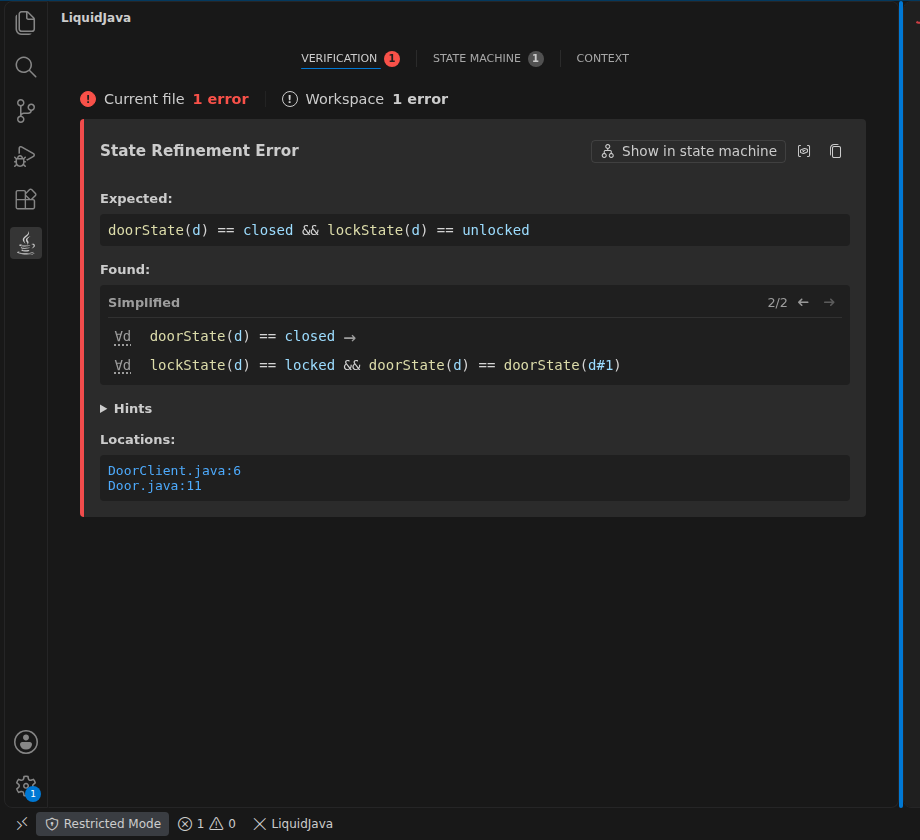
with the error message (`doorState(d) == closed`). A state set without a
name keeps its states as the title, as now.

## Checked, no change needed

The verifier sends the same shapes to the IDE as before (`git diff
fbc5e9f6 origin/main`): `StateErrorContext` still names states by their
names, and hints are unchanged. Only the text of a state error's
message, `expected` and `found` changes, to `doorState(d) == closed` for
named sets. The client renders those strings as they come, with the
generic highlighter, and nothing in the client parses state names out of
message text: the diagram marks and the summary line use `errorContext`.
The verification view shows the new form as is (last screenshot).

## Screenshots

Headless VS Code with this branch, liquidjava-fsm#17 installed locally
as 0.2.3 and the verifier built from liquid-java/liquidjava main, on
this spec (`d.lock(); d.open();` as the error):

```java
@stateset(name = "doorState", value = {"closed", "opened"})
@stateset(name = "lockState", value = {"unlocked", "locked"})
public class Door {
    @StateRefinement(to = "doorState(this) == closed && lockState(this) == unlocked")
    public Door() {}
    @StateRefinement(from = "doorState(this) == closed && lockState(this) == unlocked", to = "doorState(this) == opened")
    public void open() {}
    @StateRefinement(from = "doorState(this) == opened", to = "doorState(this) == closed")
    public void close() {}
    @StateRefinement(from = "doorState(this) == closed && lockState(this) != locked", to = "lockState(this) == locked")
    public void lock() {}
    @StateRefinement(from = "lockState(this) == locked", to = "lockState(this) == unlocked")
    public void unlock() {}
}
```

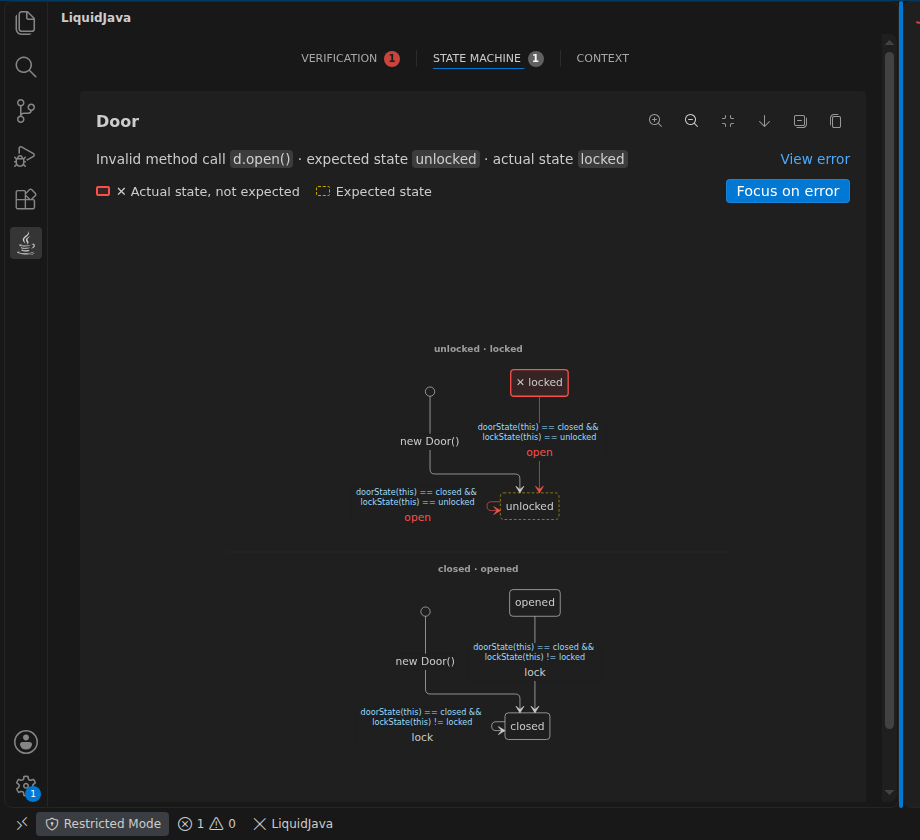
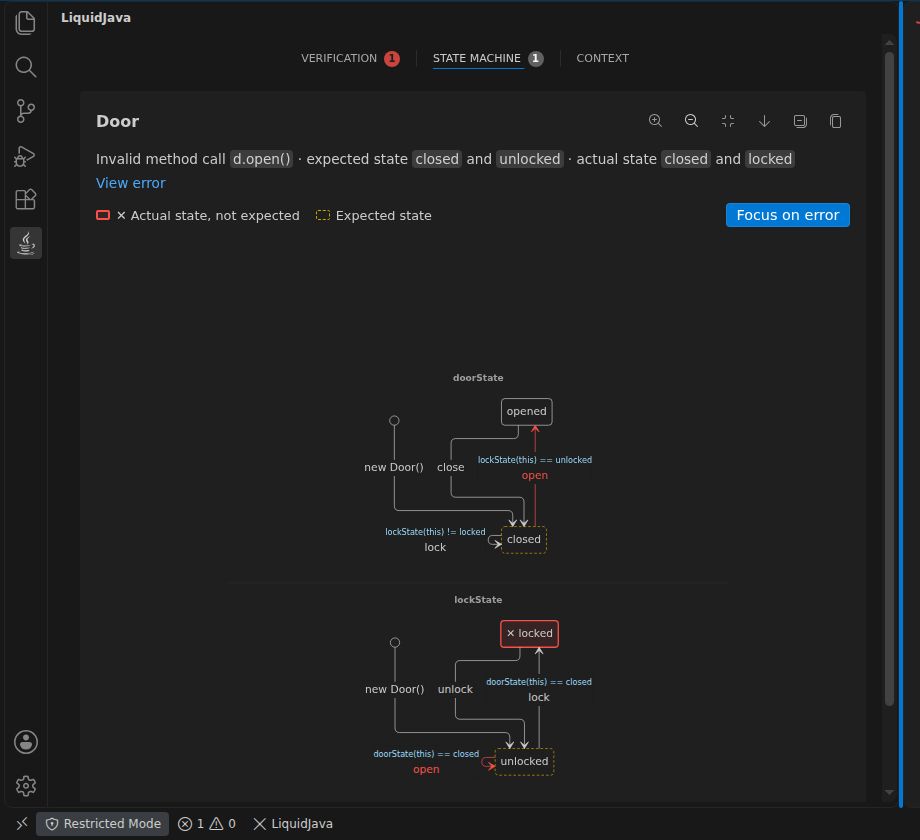
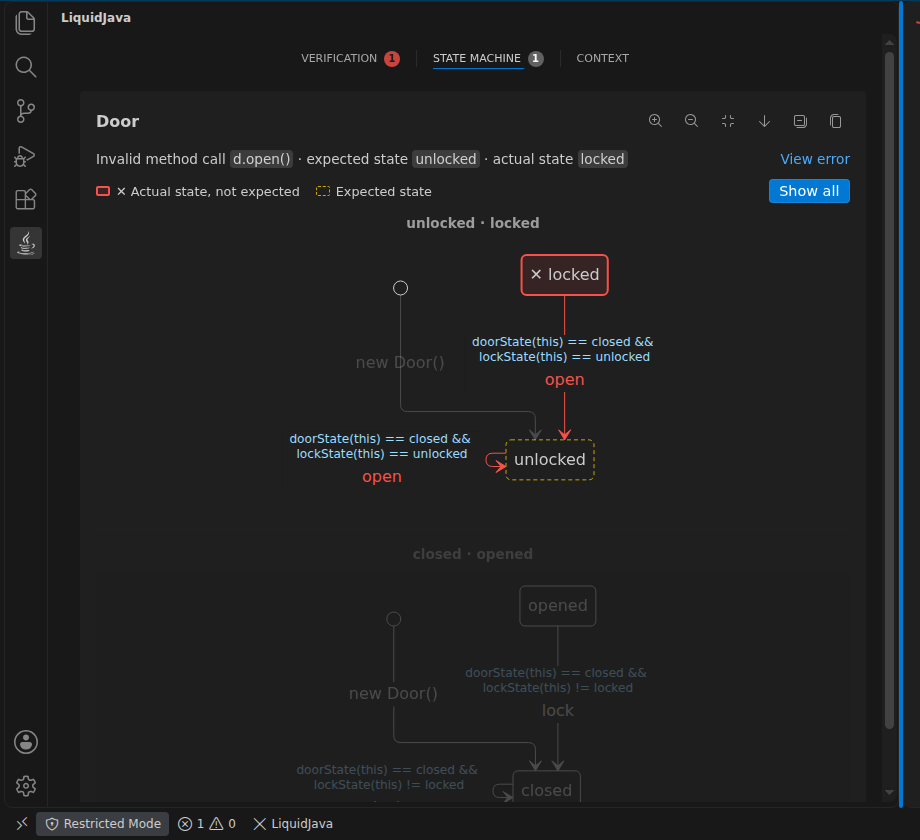
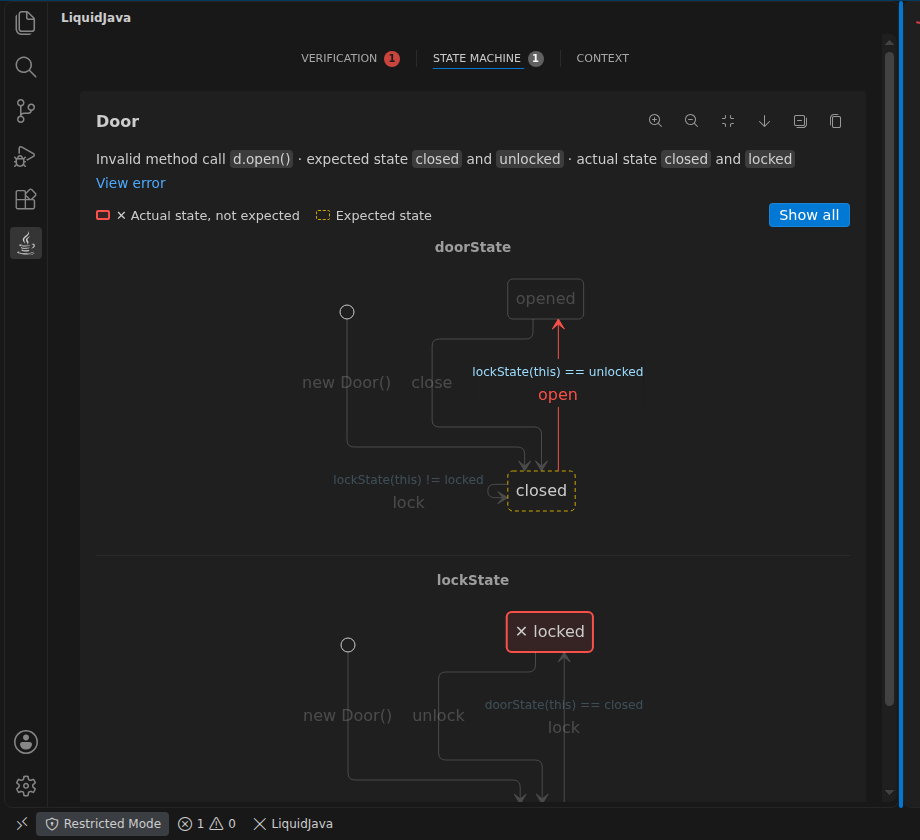
Before (main, fsm 0.2.2), the diagrams are wrong: `open` and `lock` go
from every state with the whole `from` as a condition, `close` and
`unlock` are missing, the summary only names `lockState`, and the titles
are the states. After, the diagrams match the spec, the conditions keep
the form the spec wrote, and the titles are the set names:

| | Before | After |
|---|---|---|
| Show all | <img
src="https://raw.githubusercontent.com/liquid-java/vscode-liquidjava/pr-screenshots/178/before-all.png"
width="380"> | <img
src="https://raw.githubusercontent.com/liquid-java/vscode-liquidjava/pr-screenshots/178/after-all.png"
width="380"> |
| Focus on error | <img
src="https://raw.githubusercontent.com/liquid-java/vscode-liquidjava/pr-screenshots/178/before-focus.png"
width="380"> | <img
src="https://raw.githubusercontent.com/liquid-java/vscode-liquidjava/pr-screenshots/178/after-focus.png"
width="380"> |

The verifier's message for the same error (no change here; shown for
context):

<img
src="https://raw.githubusercontent.com/liquid-java/vscode-liquidjava/pr-screenshots/178/verification.png"
width="380">

## Not in this PR

- The verifier bump: main of liquid-java/liquidjava is not released yet.
When it is, `DiagnosticConverterTest` needs the new
`StateRefinementError` constructor argument (`display`, from #511) and
the `RefinementError` one (`aliases`); the server code itself compiles
against it.
- The walkthrough and README examples stay in the shorthand until the
extension ships a verifier that accepts named sets.

## Tests

- client: `vitest run` 124 passed (one new test, fails without the
change), typecheck and lint clean
- server: `mvn test` 35 passed, against liquidjava-fsm#17 installed as
0.2.3 in an isolated local Maven repository

🤖 Generated with [Claude Code](https://claude.com/claude-code)

Co-authored-by: Claude Opus 5.5 <noreply@anthropic.com>
This file contains hidden or bidirectional Unicode text that may be interpreted or compiled differently than what appears below. To review, open the file in an editor that reveals hidden Unicode characters.
Learn more about bidirectional Unicode characters
Sign up for free
to join this conversation on GitHub.
Already have an account?
Sign in to comment

Add this suggestion to a batch that can be applied as a single commit.This suggestion is invalid because no changes were made to the code.Suggestions cannot be applied while the pull request is closed.Suggestions cannot be applied while viewing a subset of changes.Only one suggestion per line can be applied in a batch.Add this suggestion to a batch that can be applied as a single commit.Applying suggestions on deleted lines is not supported.You must change the existing code in this line in order to create a valid suggestion.Outdated suggestions cannot be applied.This suggestion has been applied or marked resolved.Suggestions cannot be applied from pending reviews.Suggestions cannot be applied on multi-line comments.Suggestions cannot be applied while the pull request is queued to merge.Suggestion cannot be applied right now. Please check back later.
Refs #435 (first part: named sets only; carrying a set per branch stays open).
What
@StateSettakes an optionalname:A named set's ghost function is called by that name instead of the generated
stateN. Messages, hints, simplification steps and the equalities that keep unmentioned sets (AuxStateHandler.getMissingStates) showredo(um)instead ofstate3(um). Specs can use the name anywhere a ghost works, for exampleto = "return ? undoable(this) : undo(this) == undo(old(this))". It works in classes, interfaces and@ExternalRefinementsForspecs. Unnamed sets keepstateNwith the same numbering, so existing specs behave the same.Checks, all reported as
Error(CustomError, the same kind as "State names must start with lowercase"), on the name:old/true/false@Ghost/@RefinementPredicateghost or another set of the class (generatedstateNincluded). An alias can't clash, because alias names start with an uppercase letter.Before / after
Study variant A1_56 (redo guarded, undo not), with the names
phase/undo/redoon the spec:Before:
After:
ErrorStateHintMultipleSetswith its sets nameddoorStateandlockState(rebased on #495, which leaves out the unrelatedunlocked(d@26)):New errors:
Tests (each fails on main)
state_hint_study_undo_manager_correct: an external spec with named sets.canUndo()keeps its undo set by name (undo(this) == undo(old(this))) when it returns false. On main the name is unknown, so this fails.ErrorStateSetNames: invalid name and clashes with a state, a ghost and another set.TestStateHints#foundKeepsANamedStateSetByItsName: exact message withdoorState(d).Full suite passes locally (714 tests). The 6 study exercises and the 19 study variants give byte-identical output to main without names. With names on every multi-set exercise spec, the verdict and line stay the same.
API release needed
name()is new inliquidjava-api. The in-repo api is still0.0.7, which is already published withoutname. Reactor builds from the root (CI and the shaded jar) use the in-repo module. A standalone build of the verifier, or any user project (VS Code study projects included), resolves the published0.0.7, where@StateSet(name = ...)does not compile. Before anyone uses names:./release.sh api(→0.0.8, which also bumps the verifier/example dependency), then a verifier release. Nothing is published in this PR.Notes
oldworks on the receiver, as for every ghost:undo(old(this)).old(undo(this))(the form in the issue) is not supported for any ghost today.tothat only mentions the set function (e.g.undo(this) == ...without any of its states) does not count as mentioning the set, so the keep equality is still added (same as forstateNtoday).server/.../GhostDTOmarks states with the regex^state\d+\(_\) == \d+$. States of a named set would show as "ghost" in autocomplete and the context view. UseghostState.getParent() != nullinstead. Set names are not offered in autocomplete, becauseContextHistoryonly carriesGhostStates. The state machine view (liquidjava-fsm) readsvalueof the first@StateSet, so it is unaffected (fsm#8 could use names as titles).🤖 Generated with Claude Code