
Fast, efficient execution of GRACE-1L, GRACE-2L and GRACE-3L interatomic potentials without TensorFlow, PyTorch or JAX.
CPU execution is standalone; GPU execution uses Kokkos for NVIDIA CUDA and AMD HIP.
Use ASE-compatible calculators, batch processing, an optional TorchSim adapter or the shared kernels in LAMMPS with MPI.
PACE (ACE) potentials fitted with pacemaker run from their .yaml (PACE models).
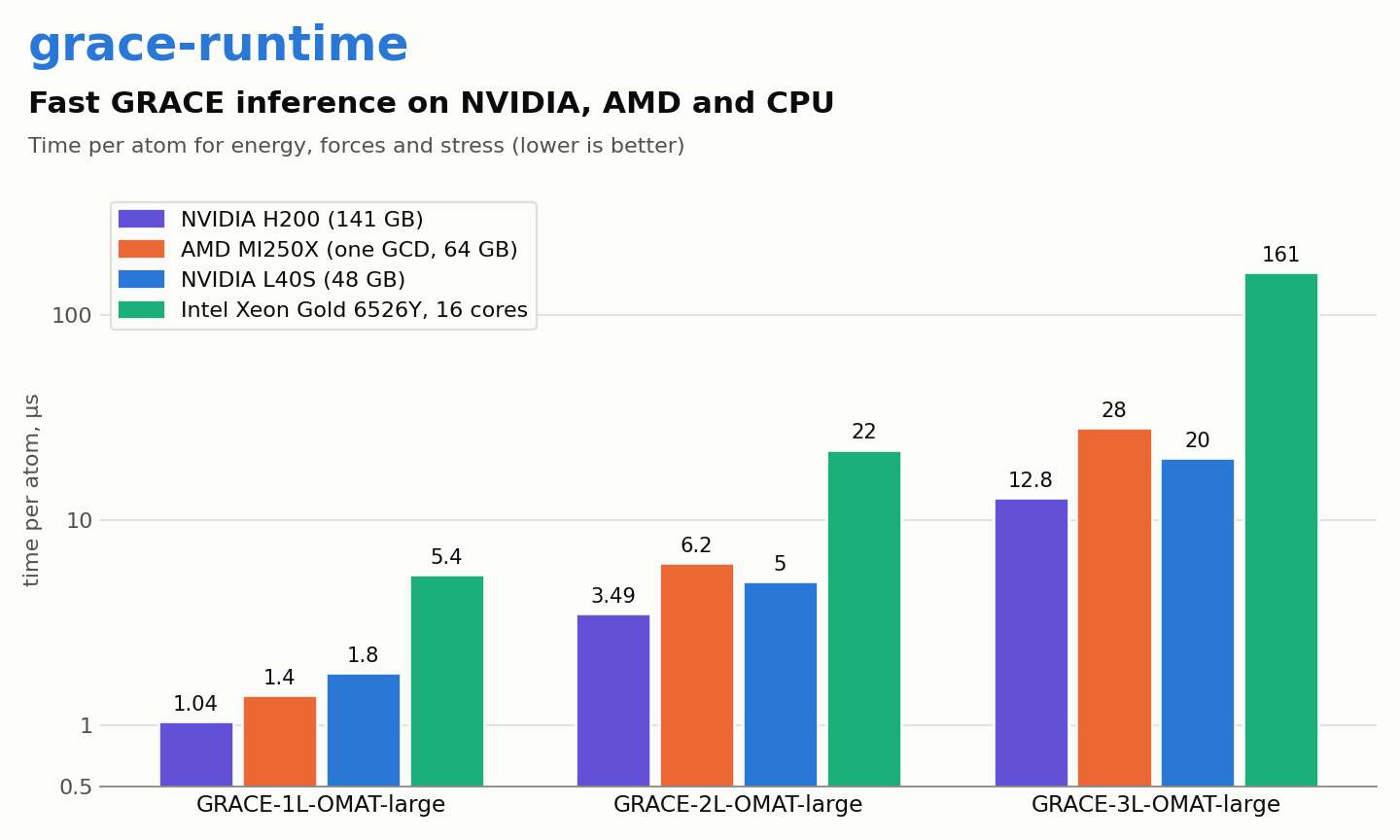
One call computes energy, forces and stress. On one NVIDIA H200 that takes about 1 µs per atom for GRACE-1L, 3.5 µs for GRACE-2L and 13 µs for GRACE-3L (large OMAT models); a 16-core Xeon is 5 to 13 times slower. Benchmarks gives the setup and the largest system per GPU.
Read the manual · Installation · API reference
Install one package from PyPI (source builds for other targets):
| Backend | Install |
|---|---|
| CPU | pip install grace-runtime |
| NVIDIA | pip install "grace-runtime-cuda12[cublas]" |
| AMD | pip install grace-runtime-rocm6 |
GPU packages install the matching CPU package automatically. See the manual for GPU requirements and environment setup.
from ase.build import bulk
from grace_runtime import GRACERuntimeCalculator

atoms = bulk("W", "bcc", a=3.165, cubic=True)
atoms.calc = GRACERuntimeCalculator("GRACE-2L-OMAT-medium-ft-E")
print(atoms.get_potential_energy())  # eV
print(atoms.get_forces())            # eV/Å; reuses the calculation above
print(atoms.calc.backend)
Device and CPU-thread selection are automatic. Energy, forces and stress are computed together and cached.
Named models download on first use; local kokkos.npz files work too.
The manual covers batching and MD, relaxation, properties, dispersion, PACE models, TorchSim and development. An interactive tour is in the ASE notebook.
The LAMMPS fork supplies pair styles
grace/runtime (CPU) and grace/runtime/kk (GPU), which take the GRACE-1L / 2L / 3L model from the kokkos.npz given to
pair_coeff, and pace/runtime(/kk) for PACE models. Installing the Python package does not install LAMMPS:
build and run it.
Academic Software Licence (ASL, LICENSE.md): academic non-commercial use. For commercial use contact ACEworks GmbH, contact@aceworks.works. Bundled third-party code keeps its own licence (THIRD_PARTY_NOTICES.md). Changes: CHANGELOG.md.
Please cite:
- Y. Lysogorskiy, A. Bochkarev, R. Drautz, Graph atomic cluster expansion for foundational machine learning interatomic potentials. npj Computational Materials 12(1), 114 (2026), https://www.nature.com/articles/s41524-026-01979-1
- For UQ (extrapolation grade
gamma): Y. Lysogorskiy, A. Bochkarev, R. Drautz, A latent-space extrapolation grade built into graph atomic cluster expansion foundation potentials. arXiv:2609.40060 (2026), https://arxiv.org/abs/2609.40060 - A. Bochkarev, Y. Lysogorskiy, R. Drautz, Graph Atomic Cluster Expansion for Semilocal Interactions beyond Equivariant Message Passing. Phys. Rev. X 14, 021036 (2024), https://doi.org/10.1103/PhysRevX.14.021036
@article{lysogorskiy2026graph,
  title={Graph atomic cluster expansion for foundational machine learning interatomic potentials},
  author={Lysogorskiy, Yury and Bochkarev, Anton and Drautz, Ralf},
  journal={npj Computational Materials}, volume={12}, number={1}, pages={114}, year={2026},
  doi={10.1038/s41524-026-01979-1}
}
@article{lysogorskiy2026calm,
  title={A latent-space extrapolation grade built into graph atomic cluster expansion foundation potentials},
  author={Lysogorskiy, Yury and Bochkarev, Anton and Drautz, Ralf},
  journal={arXiv preprint arXiv:2609.40060}, year={2026}
}
@article{PhysRevX.14.021036,
  title={Graph Atomic Cluster Expansion for Semilocal Interactions beyond Equivariant Message Passing},
  author={Bochkarev, Anton and Lysogorskiy, Yury and Drautz, Ralf},
  journal={Phys. Rev. X}, volume={14}, pages={021036}, year={2024}, doi={10.1103/PhysRevX.14.021036}
}